Research
Research
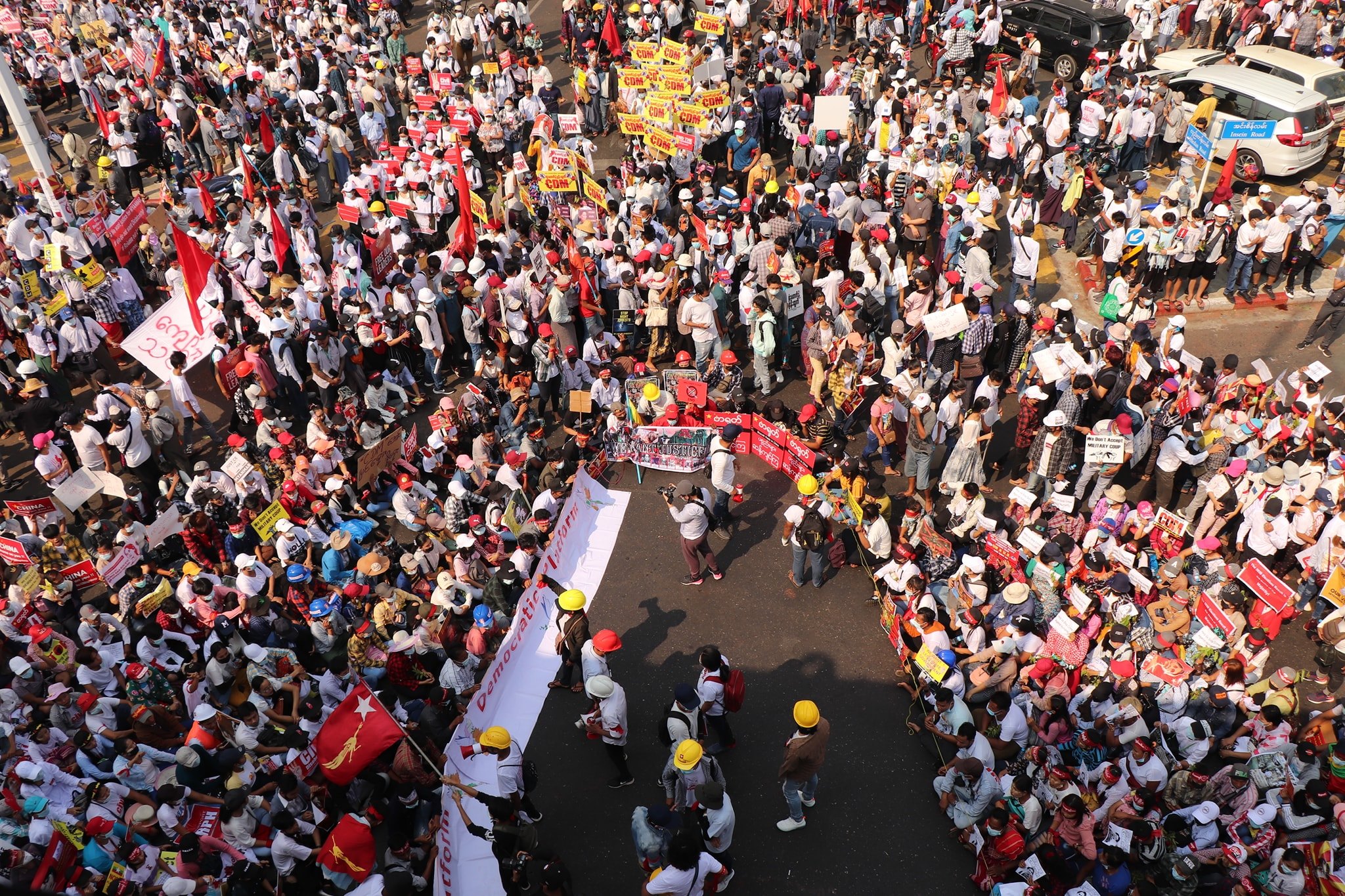
The Democratic Advocate Database intends to honor the work of non-violent advocates who have labored for a democratic and human rights based government for Myanmar. In doing so, BDFWG is also working to address the erasure of this history of non-violent democratic advocacy by successive generations of military junta leaders. We believe the Myanmar people must understand their past if they are to build a peaceful future.
If you are unsure of any organization listed in the advocate biography, you may explore our key organization list for additional information. If you have any suggestions for advocates to feature, please contact us.
23 of 23
Nang Khin Htwe is a Burmese Politician born on May 10, 1954. She was born to Ahmar and Dr. Saw Hla Tun, the former Chief Minister of the Kayin State. Her political activism career started during her time at the Rangoon Institute of Economics. During her second year there, she was involved with the June Student Demonstration, where they protested for five days against the military government. In 1975, Nang Khin and 212 other students were rounded up in the pagoda district of Rangoon and subsequently imprisoned by the military government. The government then deemed it illegal to have public assemblies and demonstrations. This set off a wave of more protests for the coming months, which led the government to close Burmese universities. After being imprisoned for the demonstrations, Nang Khin was released in 1978. She was politically quiet for a few years until she was elected as the Pyithu Hluttaw MP for Constituency No. 3 of Kayin State in the 1990 elections. She had an overwhelming majority of 74% of the votes, but in the end, was not allowed to assume her seat. On February 10, 1998, she was arrested again by intelligence officers who followed her from her house to the Rangoon 51st Anniversary of Union Day celebration. She was allegedly targeted because of an earlier argument with Major Khin Maung Kyi, who was the commander of the intelligence agency that arrested her. She was arrested and convicted under Penal Code Article 353 after arguing with intelligence officers who were searching her bag and didn't return all the items. While in prison, she was denied legal representation. She was released in February 2020. In the 2012 Election, she won the MP seat for Kayin State, and in the 2015 Myanmar General Election she was elected Chief Minister of Kayin State. After the 2021 Myanmar coup on February 1, Nang Khin was detained by the Myanmar Armed Forces. She was found guilty of five corruption charges with each assigned 15 years for a total of 75 years in prison. She was sentenced to the maximum charge, as predicted by the circumstances of the case. Some of the sentences include corruption through using state funds to pay for her medical bills and moving money for public projects to a private bank. When asked about her charges, Nang Khin said that she felt "no sense in saying whether it's fair or not." Initially, she was put on house arrest, but after a video surfaced that she made of her calling soldiers to unite with the public, she was arrested again and put in Hpa-an prison.
In Memoriam
Born on March 26, 1981, in Yangon, Myanmar, with little freedom of speech, expression, or press, Phyo Zeya Thaw grew up in a highly oppressive regime. In his formative years, however, he lived through major revolutions like the "8888" revolution, which could have helped plant the seeds of democracy that would dictate his views in adulthood. After graduating from Yadanabon University with a degree in English in 2003, Phyo Zeya Thaw set to work continuing to expand his already popular hip-hop group. After his group's release of Acid, Myanmar's first hip-hop album, he gained much popularity. Despite experts predicting a spectacular failure resulting from the release of the album, Thaw's angry style and poetic lyrics managed to resonate with the public. Specifically, his focus on everyday struggles and subtle criticisms of the Myanmar government allowed the public access to a much-needed outlet for political discontent. Thaw also used his platform to promote various social initiatives. He would frequently partner with celebrities, poets, comedians, and others to raise money or lead similar projects for social welfare. Eventually, Thaw started to take a more direct stance against the government's oppressive tactics, becoming a key founding father of the Generation Wave movement. The movement was started after the Saffron Revolution and made use of graffiti, posters, stickers, and films to spread pro-democracy and anti-government materials. Thaw was responsible for much of the movement's success and popularity amongst the younger population of Myanmar. However, not long after the start of the movement, he was arrested in 2008. After serving three of the five years of his sentence, Thaw was released in 2011. Promptly, he aligned with other popular pro-democracy figures like Aung San Suu Kyi and became a member of the National League for Democracy. In 2012, he was successfully elected to office in the Myanmar House of Representatives and served until 2016. Unfortunately, however, in 2021, after the military coup in Myanmar, Thaw was once again arrested. After facing intense torture, he was executed with other prisoners on July 23, 2022, in an internationally condemned violation of human rights.
Born in September 1995, Wai Moe Naing has risen to become one of the most prominent and influential leaders in Myanmar's anti-coup movement. His work started at thirteen when he began writing and being published in local newspapers for his short stories that touched on the current state of Myanmar. As time progressed, Wai Moe Naing moved away from writing short stories and became one of the most action-driven leaders in his community. As a part of Monywa's General Strike Committee and the Sagaing Regional Youth Committee, Wai Moe Naing began organizing daily protests in February 2021. These protests, located in his hometown of Monywa, garnered national attention, reaching hundreds of thousands of individuals and spreading the word of the anti-coup movement. Wai Moe Naing has also been credited for the idea of banging pots and pans during the nighttime hours to show resistance against the military. According to local organizers, the sound is derived from a traditional ritual that is meant to remove evil from one's household. The sound created can be heard across the country and has become a nightly act of resistance against the military, both physically and spiritually. In April of 2021, after three months of leading daily protests in Monywa, he was arrested after being hit by a car on his scooter and restrained by Junta-affiliated plainclothes officers who held him at gunpoint. His arrest was captured on film and circulated through social media, encouraging more people to get involved with the anti-coup movement in Monywa. His arrest also led organizers across the country to speed up plans and promote more activism, fearing that the military government may become more aggressive. Wai Moe Naing spent the summer of 2021 in military custody, with images showing him brutally beaten. These images circulated around Myanmar, sparking outrage about the torture techniques used against those who are imprisoned. Almost a year later, after being charged with treason, incitement, and a number of other crimes, he was sentenced to ten years in prison on August 12th, 2022. His sentencing was called unjust by numerous international and domestic organizations. His sentencing was also watched by many other nations, including Sweden, which consistently advocated for the proper treatment of Wai Moe Naing.
Min Ko Naing, born in Yangon, is one of the most influential political activists in the recent history of Myanmar. Min Ko Naing, meaning "Conqueror of Kings", is his popular alias that stands in place of his real name, Paw Oo Tun. Naing, who majored in Zoology at the Rangoon Institute of Technology during the 1980s, was first exposed to activism during his time at the university. He recounts that in the middle of his college's campus, there was a telephone booth that represented the only location where freedom of speech could exist. On this booth, students would frequently post cartoons airing their grievances against the university, the government, or other institutions that they couldn't traditionally criticize. Inspired by his peers' cartoons, Naing decided to try his hand at creating similar drawings that he could post on the booth. His drawings, as he recounts, weren't quite as popular as other students'. Nevertheless, this taste of freedom had drawn Naing to express his political discontent elsewhere, and more publicly: he became a member of a performance troupe that frequently ridiculed the Myanmar government for its policies and system of rule. His political expression didn't last long, however, as the Burmese Military Intelligence agents quickly tracked him down and stifled his opposition. Still, despite his encounters with the Burmese military, he continued to meet with other students in secret to discuss the political state of his country and what could be done to improve it. These student organizations would prove to be vital in future protests. In 1987, the Myanmar government removed many denominations of their currencies, creating much discontent and financial distress. The impact was largely felt by students saving to pay their college tuition. Taking advantage of this discontent, Naing helped organize a protest consisting of 3,000 students on a college campus. It was quickly met with police force, leading to many deaths. Naing continued to organize various protests in this movement that would come to be known as the "8888" movement. This led to him helping Aung San Suu Kyi, the daughter of Aung Sang (an influential and famous figure who helped Myanmar gain independence from the British) gain an audience to speak to crowds of protestors. Today, Aung San Suu Kyi remains a key political figure in the fight for democracy in Myanmar. For his work, Naing was punished severely by the government. He was sent to prison until 2004, allegedly enduring intense torture and mistreatment. Naing was arrested again in 2007 for his pro-democracy work and sentenced to 65 years in prison, but was ultimately released in 2012. After spending nearly two decades in prison, Naing continues to advocate for democracy in Myanmar and now is on the run from the Myanmar government following a violent military coup that took place in 2021.
Nasir Zakaria was born in Buthidaung in the Rakhine State of Myanmar. His identity as a Rohingya man put him in the face of immense persecution throughout his life in Burma. When he was fourteen years old, military officials abducted him, but Zakaria luckily escaped and fled to his uncle's home. From a nearby village, his father urged Zakaria to leave Myanmar at once and relocate to Bangladesh, where he'd be safer. Zakaria obeyed the pleas of his father and spent the next 15 years working construction jobs in several countries. He lived and worked in Bangladesh, Malaysia, where he was arrested twice, and Thailand before his visa to come to the United States as a refugee was finally approved. In 2013, he relocated to Chicago with his wife, daughter, and an elderly Rohingya man from Malaysia, who Zakaria grew to love as his own "adopted father." As one of the first Rohingya refugees to arrive in the city, Zakaria, who knew little English, experienced the difficulties of language barriers and unemployment for quite some time. He was able to find a job as a dishwasher at a restaurant downtown, but it was his subsequent job at the Rivers Casino that inspired his vision to band together with other Rohingya in the area. At the casino, he befriended a woman who was a member of a labor union and taught Zakaria the purpose and value of establishing a union to protect its workers, leading to his objective of establishing a safe haven in which Rohingya would be able to gather and embrace their identities. Through this same friend, Zakaria was later introduced to the Zakat Foundation of America, a non-profit organization based in Chicago that provides support services and funding to Muslims in need. Upon this introduction, Zakaria proposed to them his idea of creating a place for Rohingya to prosper in America. In 2014, the foundation approved Zakaria's plan and agreed to pay rent for one year on the space that Zakaria would elect for his center. In April 2016, after quitting his job, Zakaria officially opened the Rohingya Culture Center in Chicago and began working full-time as its Executive Director. Exactly as he had envisioned, the center aims to provide services for the increasing numbers of Rohingya refugees in Chicago. Through this organization, and in collaboration with other employees at the center, Nasir has worked to open English-learners programs, academic and athletic groups for the youth, religious education services, and several other support groups for those who have recently arrived in the United States. Today, he continues his efforts in raising awareness and support for the ongoing Rohingya genocide and crisis taking place in Myanmar at the hands of its government. He has spoken with leaders around the world in an effort to gain their financial and media support.
In Memoriam
Ko Jimmy was born on February 13, 1969, in the state of Shanland in Myanmar. During his early years, the military regime ruled over the country and popular discontent was slowly accumulating, especially among the youth. Ko Jimmy was only a 19-year-old physics student at Rangoon University when the 8888 Uprising began, and yet he would eventually become one of the leaders of this "88 Generation" of student democracy activists. Before then, however, he was arrested just like any other protestor and sentenced to fifteen years in Insein Prison. Ko Jimmy felt incredible fury at his treatment, becoming completely miserable while in jail. However, his perspective on the world started to change when he began to interact with a Buddhist monk who became his cellmate. The monk taught him about "vipassana meditation," a form of Indian meditation that was meant to teach its practitioners to "see things as they really are." Ko Jimmy's temper calmed, and he even started to feel sympathy for the guards around him, seeing them not as enemies but as fellow victims of the system. He would use his compassion to his advantage, leveraging it to cease the endless beatings and to even allow himself the requisite paper and pens needed to start writing. During his prison sentence, Ko Jimmy wrote many poems and stories, most of which revolved around heroes that fought for freedom, though he would also do work in translating "The Da Vinci Code" using an English dictionary. Writing and meditation were not the only pastimes that Ko Jimmy engaged in while in prison. He formed a close bond with a fellow inmate named Nilar Thein, who had also been a protestor during the 8888 Uprising. They exchanged notes with one another, discussing political ideals and famous thinkers. Two years after meeting, Ko Jimmy proposed to Nilar Thein. After being released from prison in 2003, they would marry. They eventually had a daughter named Nay Chi Min Yu, meaning 'sunshine,' in hopes that she would see a brighter future for Myanmar. Even after being released from prison after fifteen years of confinement, Ko Jimmy and his wife continued their work to bring about a more democratic Myanmar. In 2007, they were arrested again for helping lead the Saffron Revolution, though this time they were kept in separate prisons. Upon being released in a mass pardon in 2012, Ko Jimmy reunited with his family and continued his work as an activist, with Ko Jimmy and Nilar Thein helping found the non-profit "88 Generation Peace and Open Society." These pleasant times would not last, as Ko Jimmy became one of the many targets of the military regime following the coup in 2021. Ko Jimmy was arrested for planning terrorist attacks on schools and government buildings, an accusation many have disputed. Ko Jimmy was executed on July 23, 2022, sparking immense outrage in Myanmar and across the world.
In Memoriam
U Win Tin, a longtime journalist and democratic activist, was born on March 12th, 1929 in Gyobingauk Township, located in southern central Myanmar. He was born to parents U Pu and Daw Mar. In Yangon, he attended Myoma High School and Yangon University. He graduated from Yangon University with a Bachelor of Arts degree in 1953. He began his writing career working as a journalist in France with the Agence France-Presse, the oldest news agency in the world. He continued his career with a publishing company in the Netherlands and later, he returned to Myanmar and worked with several Burmese newspaper companies. From 1962 to 1988, he used his involvement with journalism to criticize the military regime, often using pseudonyms to protect himself from government scrutiny. In 1964, following its nationalization, Win Tin became editor-in-chief of Kyemon, a popular Burmese newspaper. After working with Kyemon for five years, he served as editor-in-chief of the Burmese newspaper, The Hanthawaddy Daily, after being appointed by the military leader, General Ne Win. Despite the fact that The Hanthawaddy Daily was state-owned, Win Tin continued to publish stories critical of the military government, ultimately leading to his removal and the termination of publications from the newspaper in 1978. U Win Tin's life from the period of 1978 to 1988 is not well documented, but it is known that in 1988, he and several other pro-democratic activists formed the National League for Democracy. He worked with Aung San Suu Kyi and others to lead nonviolent opposition movements. Because of his activity with the NLD and NLD-sponsored Civil Disobedience, he was arrested on July 4th, 1989. He was sentenced to 20 years in prison after being charged with "anti-government propaganda" and served his time in the Insein prison. In his memoir, What's That? A Human Hell, published in 2010, Win Tin detailed the abusive conditions he endured in the Insein prison, such as being placed in solitary confinement in a cell used for holding dogs; experiencing frequent abuse and torture by prison officials; and being denied food, water, and medical treatment. In 1996, after sending documentation and written accounts of the prison conditions to the United Nations, his sentence was extended another seven years. While in prison, military officials gave Win Tin the ability to renounce his beliefs once annually and move toward release, but each time he denied the offer. After 19 years in prison, he was released by the military government. While they first granted him release on general amnesty, Win Tin refused to leave until the military government granted him unconditional release. Despite his release, Win Tin continued to show solidarity with other political prisoners by wearing the same blue prison shirt daily. He also resumed his criticism of the military government through various means, such as starting a radio show and newspaper column. Win Tin also strengthened the NLD by regularizing the Central Executive Committee meetings and continuing to support political prisoners. Until his death on April 21st, 2014, he protested the military government and its imprisonment of opposition members. He is currently buried in Yayway Cemetery. His longtime commitment to challenging the military government through journalism and political activism made significant contributions to the progress of the NLD and democracy movements in Myanmar. His work was recognized by many, and he received both the UNESCO/Guillermo Cano World Press Freedom Prize and the World Association of Newspapers' Golden Pen of Freedom Award in 2001 for his efforts.
In Memoriam
Before the coup, Khet Thi was a man of artistic and refined tastes, having quit his job in civil engineering to open a cake and ice cream shop in the town of Shwebo in 2012. He used the shop to support his career in poetry, which bloomed with verses all about "love and life," according to his friend Nyein Chan. While Khet Thi had participated in protest movements before, such as in the Saffron Revolution, he truly came into prominence following the police murder of K Za Win - a fellow poet and Khet Thi's close friend. During the funeral service of K Za Win, Khet Thi read what would come to be his most famous poem. Titled "Shin Than Chin Shindan," the poem was not only a celebration of K Za Win, but it was also an urging of hope to the despondent people, stating "they shoot in the head, but they don't know that the revolution is in the heart." Khet Thi's poem would go viral on social media, giving him a significant online presence that posed a potential threat to the military regime. This was amplified by the fact that Khet Thi was physically established in the central town of Shwebo, located in the Sagaing region - a locus of protest and resistance against the military coup and regime. And yet, despite this danger, Khet Thi only grew more and more determined and stalwart in his resistance as time went on, expressing frustrations through his poems, stating "my people are being shot and I can only throw back poems... but when you are sure your voice is not enough, then you need to choose a gun carefully. I will shoot." On May 8, 2021, both Khet Thi and his wife were taken in for "interrogation" by local police officers and soldiers. While his wife was ultimately released, Khet Thi was tortured, mutilated, and ultimately beaten to death at the age of 45, making him the 780th civilian victim of the Burmese military regime since the coup. While the army initially planned on burying his corpse, Khet Thi's wife begged for the return of his body - which ended up being given to her with its organs removed, a common intimidation tactic utilized by the regime against celebrities and other well-known figures like Khet Thi. Khet Thi's funeral was held on May 10, an event attended by thousands of protestors who came to pay their respects to him. A month later, protestors held a "black movement" to commemorate the poet's life and death, reciting poems and praying for fallen martyrs like Khet Thi and others.
Shwe Nya Wah Sayadaw was born in 1965 in the Yamethin District, Mandalay Division, Burma. He is a Burmese Theravada Buddhist monk. Sayadaw taught at Yangon Buddhist University, located in Kyimyindaing Township in Yangon. Best known for being an outspoken monk, he has spoken publicly about human rights. He criticized the anti-Muslim 969 Movement, which was supported by many nationalist monks. Not only does he criticize the movement against Muslims, but he also is very against the government of Myanmar. To this end, he supported a student-led movement that was full of student demonstrators demanding a change in the Education laws. Sayadaw criticized the government's restriction on the freedom of assembly in the student movement. Sayadaw is very adamant that Buddhist monks should not be below any authority, since in the day of the Buddha, nobody was above the monks. He believes that monks have a duty to find and point out the weaknesses of the government in the interest of the civilians, which is an idea that the government vehemently disagrees with. This is a prime example of the government's controlling nature: because of its fear that the monks will have far too much power, it does not allow monks to perform their roles according to Buddhist beliefs. He has accused his fellow monks of corruption and stated that they are not living up to their roles as Buddhist monks the way they should. By supporting anti-Muslim movements, supporting the government, and not speaking out against the government, he believes monks are not fulfilling their roles as they should be. Shwe Nya Wah Sayadaw met with Western delegates such as Hillary Clinton and the US Secretary of State in December 2011. His work as a democratic activist has been quite significant. Because of the threat he poses to the government, Myanmar's monastic council, controlled by the state, ordered an indefinite ban on speaking against Sayadaw. The reasoning behind it was that he apparently "spoke out of line" from Buddhist doctrine and did not follow the directions and instructions of his seniors. Although there is a ban in place to silence him, Sayadaw continues to advocate for democracy and is fighting the ban. This ban also serves to illustrate that the government is targeting religious leaders critical of the government, especially because monks have historically had a lot of power. Though he was detained by the Myanmar armed forces during the 2021 coup, he continues to speak for what he believes with the interest of the people in mind. The government is still attempting to silence those who voice concerns about unjust governmental actions, but activists like Shwe Nya Wah Sayadaw are those who allow for some hope for the future of Myanmar.
Tayzar San is a 33-year-old physician who graduated from the University of Medicine in Mandalay. Upon graduating from medical school, he remained true to his roots, creating an informal education library with a close group of friends named "knowledge society." At the same time, Tayzar San also was employed at a non-governmental organization focusing on public health and political education. Tayzar San remained in this capacity until the Junta overthrew Myanmar's democratic government. While Tayzar San was not politically active before the coup, he was the first to speak up the night that the Junta overthrew the government. Immediately after the coup happened, the nation was silent for a few days until Tayzar San organized the first protest in the country against the Junta. During this protest, Tayzar San led a few dozen other individuals in Mandalay while thousands of others watched, expecting brutal outcomes. After 30 minutes of demonstrating, no action was taken by the junta, sparking nationwide protests in response. Tayzar San's protest encouraged a collective resistance against the Junta. He was the first to speak out publicly against the coup at the risk of being tortured and/or killed. Hundreds of other protests arose across Myanmar in the following days. Videos of Tayzar San holding a megaphone leading his rally demanding the release of democratic leaders circulated Myanmar's social platforms, sparking even more motivation. Even today, he often posts on his Facebook while hiding messages of encouragement stating that "uprising must win" and "fight the common enemy." However, his work that day did come with consequences; in April of 2021, the Junta announced a 10 million kyats bounty on him equivalent to 7,000 USD. He has since been in hiding and has shared reports the plainclothes soldiers have raided his old addresses. While in hiding, Tayzar San continues to organize through the National Unity Consultative Council (NUCC), while working to establish the framework of a democratic government after the removal of the Junta regime. His work over the last year has received many commendations from organizations and nations such as South Korea awarding him the Park Jong-Cheol Human Rights Award.
Khun Saing was a medical student at Rangoon University when he was faced with his first major wave of protests. These protests began due to the death of famous Burmese UN diplomat U Thant. While celebrated by the students of Myanmar as a world leader, the government refused to give U Thant a state funeral, as the President and military dictator of the country, Ne Win, disliked him. When a smaller, private funeral was held for U Thant, student protestors interrupted the funeral, stole U Thant's coffin, and brought him to their compound at Rangoon University. Khun Saing, like many others, was swept up in the protest and pursuits of activism. The situation was ultimately broken by the military, resulting in as many as 100 deaths - luckily, Khun Saing happened to be visiting his home at the time. Despite this failure, Khun Saing continued to engage in the protest movement, breaking curfew, spreading pamphlets, and organizing his fellow medical students in the cause. For these reasons, he ended up being arrested by the government. After being held for eight days in a military compound, Khun Saing was given a one-day trial with no questioning and sent to Insein Prison. While he would only stay for two years out of his seven-year sentence, being let out due to the prisons being overcrowded, Khun Saing would still remain determined to fight for what he believed in, resulting in him ending up in prison two more times for a total of nearly 15 years of his life behind bars. While imprisoned, Khun Saing wrote a song about Nelson Mandela titled "Echo for Mandela," which he would secretly teach to his fellow inmates in a quiet act of rebellion against the prison guards. Khun Saing put himself to work for the sake of his fellow prisoners, whom he believed were enduring terrible conditions. By his words, there was not enough medicine, nor enough doctors in the prisons Saing experienced - resulting in many prisoners dying. To rectify this, Khun Saing smuggled in stashes of medicine to treat any prisoner he could help, nearly dying from tuberculosis himself from exposure to sick prisoners. After being let out of prison and despite being banned from working as a doctor by the regime, he founded the Nightingale Special Clinic - named after his personal hero - which gave free and cheap medical treatment to the poor, political activists, and members of the National League for Democracy. In 2007, Khun Saing applied for asylum in the UK. His request was granted, and he resides there today in a Sheffield bakery. His wife and son, however, are still waiting for their chance to join him and are currently refugees in Thailand.
Salai Lian Hmung Sakhong is a Chin politician representing the Chin ethnic group, one of the founding groups of the Union of Burma. Little is currently known or recorded about his early life. Salai Lian Hmung Sakhong serves as a vice-chairman of Chin National Front (CNF), a Chin nationalist political organization in Myanmar, and of the Union Peace Discussion Joint Committee (UPDJC), the top negotiating committee in Myanmar's ongoing peace process. He is also the federal union affairs minister for Myanmar's shadow National Unity Government (NUG). The NUG was formed based on the mandate of the people who overwhelmingly voted for the National League of Democracy (NLD) in the November 2020 election and the mandate of ethnic people who have engaged in revolution for many years. The NUG represents both the people and the nation according to Salai Lian Hmung Sakhong in an interview with the Irrawaddy. After the military regime illegally seized power in 2021, he is working with the NUG to cast an attempt at suspending all peace talks under the regime. As of April 16th, 2021, Salai Lian Hmung Sakhong was appointed by the Committee Representing Pyidaungsu Hluttaw, with a mandate from the Chin Consultative Assembly, as the minister of federal union affairs in the National Unity Government.
While little is documented about his early life, it is known that U Tin Oo was born on March 11th, 1927 in Pathein, Myanmar. In 1946, he began his long military career as a second lieutenant in the Burma Rifles Battalion, a branch of the colonial British Indian Army. Within the next four years, he quickly climbed the military ranks. In the late 1950s and early 1960s, Tin Oo continued serving in the Burma Rifles Battalion, serving as battalion commander. In 1964, he was promoted to commander of the Central Regional Military Command, and in 1974, he was promoted to commander in chief of the Tatmadaw as well as minister of defense. He served as commander in chief until 1976, and minister of defense until 1977. Over the span of his thirty-year military career, he led campaigns against small factions within Burma, such as the Karen National Union, an armed political group representing the Karen minority in Burma, as well as the armed branch of the Communist Party of Burma. Because of his outstanding leadership, he was awarded the distinguished Thura medal. In March of 1976, the Burma Socialist Programme Party removed Tin Oo from the position of Commander in Chief despite his successful career. The reason given for his forced retirement by the government was Tin Oo's wife (Dr. Daw Tin Moe Wai) violated military spouses' expected behavior by accepting bribes. The following year, he was charged and arrested for high treason against the government based upon the accusation that he withheld information about a coup attempt against the military leader, General Ne Win. In 1977, he was sentenced to seven years of imprisonment and hard labor. His appeals were unsuccessful. After the military government granted general amnesty in 1980, Tin Oo studied law and earned a degree. Alongside pro-democracy leaders like Aung San Suu Kyi, Tin Oo helped found the National League for Democracy (NLD) in 1988. Tin Oo continued working with the NLD and was named Vice President in September of that same year. In December, he was promoted to President. Because of his involvement in the NLD which was seen as a threat to the newly instated military junta, Tin Oo was placed on house arrest in 1988 and ended up serving three years in prison starting in 1989. There is little documentation about Tin Oo's activities during the 1990s, but it is assumed that he was working to promote democratic reform alongside members of the NLD. Despite their victory in the 1990 parliamentary elections, the NLD was still repressed by the military government. In 2003, members of the NLD campaigned across Myanmar, and while en route to Depayin, a northern township, the military sponsored an attack against the NLD and its supporters. While unharmed, Aung San Suu Kyi and Tin Oo were both arrested by the junta, and imprisoned in Kalay. His sentence shifted to house arrest in Yangon and was renewed annually until 2010 when he was released. From 2003 to 2010, Tin Oo was allowed no contact with NLD members. After his release, he immediately returned to NLD headquarters and continued to work for the opposition party campaign. His contributions and leadership to the NLD have made significant impacts on the pro-democracy initiative in Myanmar. His current whereabouts are unclear.
Htay Lwin Oo is a Rohingya native to Myanmar. He spent the majority of his childhood between the Thandwe Township, where he was born, and the Gwa Township in Southern Rakhine State, where he attended Kyeintali High School. When he was in ninth grade, he began to take note of the widespread oppression that people were facing, such as the destruction of mosques from Taunggouk, Gwa and Kyeintali orchestrated by the government itself. He also watched some of his Muslim friends coerced into conversion to Buddhism. In 1986, Lwin Oo pursued a college education in Sittwe, studying Burmese language and literature. After years of witnessing these injustices perpetrated by his country's own military government, he decided to participate in a democratic movement as a student leader in 1988. Two years later, he was told to leave the college and relocate to Yangon, where he made a living as a private tutor. With several of his students, he incorporated teachings of democracy and dictatorship opposition into their conversations. As his quiet activism strengthened and his devotion to the movement grew, Lwin Oo reunited with friends who had recently been released from prison. He collaborated with them to establish a means by which tapes of Aung San Suu Kyi's speeches, which advocated democracy, could be secretly issued to individuals across the country. Shortly after, Lwin Oo was warned several times by military intelligence General Shwe Win that his recent actions had caught the military's attention and that he was being very closely monitored. Despite these warnings, Lwin Oo persisted in his activist efforts. He was consequently arrested in November 1997 under the accusation of conspiring with the exiled activist group Students' Army. His interrogation upon being taken into the custody of law enforcement consisted of severe beatings with a leather belt. He was held in a cell in the Eastern Yangon jail for a total of 27 days before being released due to his connections with police officers who were his former students. As several of his colleagues began to be arrested and tortured, Lwin Oo was advised to leave Burma. Obeying his close friends' pleas to flee the country, Lwin Oo moved to Thailand, where he collaborated with human rights advocates to file reports of the injustices he has witnessed to the United Nations. In June 2003, Lwin Oo was once again arrested, this time in Thailand, where he faced deportation back to Burma, which would almost certainly lead to his death. While in prison, his political activism was broadcasted by several media outlets and subsequently gained popularity, placing pressure on the US Embassy in Thailand to send him to the United States rather than to imminent death back in Burma. Accepting this demand, Lwin Oo was resettled in America in May 2004. Between 2004 and 2008, he was the general secretary for the Democratic Burmese Community in upstate New York. Lwin Oo primarily learned English upon arrival in the US through his job as a waiter. In 2009, he opened his own grocery store, Golden Burma, which has assisted his efforts in social justice activism. He has collaborated with nongovernmental organizations, such as United to End Genocide. Later, he gathered Burmese Muslim activists internationally in order to establish the Burmese Muslim Association (BMA). Htay Lwin Oo's ongoing activism not only advocates democratic governance in Burma but also the elimination of Rohingya oppression in the nation. In September 2013, police and the 969 Movement (an anti-Muslim Buddhist nationalist movement) beat Lwin Oo's family, burned down his home, and burned down six other Rohingya houses. In October 2015, a civil lawsuit was filed by Htay Lwin Oo, along with the Burma Task Force and several Muslim organizations, against Myanmar President Thein Sein and five of Myanmar's current and former officials for the "hate crimes and discrimination amounting to genocide" perpetrated by "the Burman Buddhist supremacist government." Htay Lwin Oo, one of the plaintiffs, sued for the religious and ethnic persecution that he and the Rohingya were forced to endure and their inability to obtain citizenship. In August 2017, Lwin Oo spoke with New York congresswoman Claudia Tenney about taking steps to combat the Rohingya genocide. In 2018, he attended a convention on Myanmar's ongoing genocide with BMA. In addition to his countless other efforts to restore Rohingya rights and bring democracy to Burma, he has also participated in a number of live streams in the past year spreading awareness on the matter.
Aung Moe Nyo was born on December 13, 1958, in Pwintbyu to parents U Nyo and Daw Nyein. He graduated from the Rangoon Institute of Medicine in 1982 and started his own clinic. He won a seat in the 1990 general election and voluntarily resigned from the National League for Democracy the same year. He was arrested by the military in 1998 -- being kept without trial in military prisons called "guest-houses" -- and was released in 2001. He was then elected as a lower house parliament member in 2012 and re-elected for the Pwintphyu township. He became the Chief Minister of the Magway Region in 2016. He has recently been wrongfully charged with corruption, bribery, and incitement by the Junta. He was initially under house arrest on the day of the coup and accused of contributing to voter fraud. He was given further sentences after posting a Facebook video condemning the Junta's crackdown on the public. Now, he faces up to 90 years in prison if convicted of every count he has been accused of.
U Win Myint was born on November 8, 1951, in Nyaung Chaung Village, Danubyu, Ayeyarwady Region, Burma to parents Tun Kyin and Daw Than. For primary education, he attended Nyaung Chaung Basic Education Primary School, and for his secondary education was at Danubyu Basic Education High School. He attended the Rangoon Arts and Sciences University where he graduated with a degree in geology. He is currently married to Cho Cho and has one daughter, Phyu Phyu Thin. In 1981, after graduating from Rangoon Arts and Sciences University, Win Myint became a senior lawyer for the High Court and for the Supreme Court of Myanmar. In 1985, he became a High court advocate. He has been a member of the National League for Democracy since the creation of the party in 1988 and was jailed for his participation in the 8888 Uprising. He was released from jail shortly after and decided to run in the 1990 Myanmar general election. He ran for Ayeyarwady Region's Danubyu Township and won the majority of the vote (56%), but was never able to serve his position because the military nullified the results of the election. He ran for office again in 2012 and won a Pyithu Hluttaw, a lower house seat in the Pathein constituency, and went on to become secretary of the parliament's rule of law committee. In the 2015 Election, he was elected as Pyithu Hluttaw MP for Yangon's Tamwe Township. He also served as the Speaker of the House of Representatives of Myanmar from 2016 to 2018. When the previous president, Htin Kyaw, resigned due to health issues and a "need for rest", Win Myint resigned as Speaker of the Pyithu Hluttaw on March 21, 2018, in preparation for his presidential run as a representative of the NLD. Win Myint was elected as the 10th President of Myanmar by the Pyidaungsu Hluttaw on March 28, 2018. The Pyidaungsu Hluttaw is made up of two houses -- the Amyotha Hluttaw (the House of Nationalities -- the upper house) and the Pyithu Hluttaw (the House of Representatives -- the lower house). Win Myint was voted for by 403 out of the 636 lawmakers. During his presidency, he was considered a vital ally to Aung San Suu Kyi. She was technically his state counselor but she served as the de facto president because she was barred from running for president herself. On February 1, 2021, the military staged a coup and Win Myint was detained by the military along with other parliament members such as Aung San Suu Kyi. His presidency was overthrown by the military dictator Min Aung Hlaing and the Tatmadaw declared Win Myint's vice president, Myint Swe, to be the new president. Days later, Win Myint was charged with violating COVID-19 regulations. He was formally indicted on October 11, 2021, under section 25 of the Disaster Management Law. On December 6, 2021, Win Myint was sentenced to four years in jail.
Hla Myint was a Burmese economist born in Pathein, a large city in southern Myanmar, in 1920. At a young age, Myint lost his father, leaving him in the care of his mother, a small shop owner. However, he was quickly noticed in school for his extraordinary intelligence and talent. Myint worked at an accelerated pace and enrolled in Rangoon University at only 15 years old. While at Rangoon, he continued to be noticed for his exceptional capabilities and received an offer for a scholarship to study at the London School of Economics (LSE). Due to his incredible academic ability, the school allowed Myint to skip the typical requirement of getting a Master's degree before proceeding straight to working on his PhD, which he earned with his thesis about theories of welfare economics. He also met his wife while at LSE, who was studying economic history. In 1946, Myint returned to Rangoon as an economics professor. This career was short-lived, however, as he was drafted 2 years later as an economic advisor to the newly independent Myanmar government under U Nu. In this position, Myint urged U Nu to allow private and foreign investment in the rice trade, as it was being strangled by government policies. Unfortunately, Myint's advice and policy ideas did not align with how U Nu wanted to shape the state's policies, and his advice was not put to use. Frustrated and feeling unheard, Myint left Myanmar to be a colonial economics lecturer at Oxford. In 1958, he was back at Rangoon University, now as rector for the school. His time in Myanmar was once again brought to a close in 1962 when a military coup led by General Ne Win resulted in the forcible expulsion of many ethnically Chinese and Indian people from the country. Still stuck with the idea of a free market system focused on growing the agricultural sector, Myint returned to Oxford until 1965, when he went back to his alma mater, LSE, until his 1985 retirement. His work during this time greatly emphasized the importance of free trade, capital accumulation, international specialization, and improving the agricultural sector of a state's economy first to a thriving economy. Myint had not seen the last of Myanmar, however. At age 92, in 2012, he attended a forum in Myanmar called "An Agenda for Equitable and Sustainable Development for Myanmar," when the country was under the rule of U Thein Sein. Here, he continued to promote the theories exemplified in his life's work: a free-market system with an emphasis on growing the agricultural sector. He passed away 5 years later, in Thailand. He is remembered by many great economists worldwide as a sage and skilled classical economist.
Zaw Myint Maung was born on December 11, 1951 in Amarapura, Myanmar. While no information could be located on his mother, his father has been recorded to be Chit Maung. He is married to Yu Yu May, with whom he has two sons and one daughter. He graduated from the Mandalay Institute of Medicine with a medical degree in 1979. Utilizing his degree, Zaw Myint Maung was a chemistry lecturer at Mandalay University for five years, from 1983 to 1988, and worked in Sagaing Division's Yuthitgyi Hospital. He was elected to Parliament in the 1990 general election but was never allowed to assume his seat due to his arrest in November of the same year. He was arrested for attending meetings in Mandalay on forming a provisional government and was sentenced to 25 years. In 1991, he was dismissed from Parliament by the Election Commission and was barred from running in any future elections. He became a member of the "Organization to Protect the Rights of Prisoners," also contributing a poem called 'Noble Mother (or) To My Mother' to the Diamond Jubilee magazine and another poem entitled 'History Of The Fighting Peacock's Ability' to the New Blood Wave magazine. While in Insein Prison, Zaw Myint Maung and other political prisoners, including Win Tin, created a magazine celebrating the 75th Anniversary of Rangoon University as well as the New Blood Wave. In March 1996, this action extended his sentence seven years as all prisoners involved were charged under Article 5 of the 1950 Emergency Provision Act. He was also found to be in possession of a letter addressed to Professor Yozo Yokota, the UN Special Rapporteur on Burma, that described the circumstances and situation of the political prisons at Insein. Due to these actions, he was intensely interrogated by MIS officers, badly beaten, and tortured. Finally, in February 2009, Zaw Myint Maung was released from prison. He has served as the vice chair of the National League for Democracy and the chief minister of the Mandalay Region. Immediately following the 2021 coup, he was detained by the Myanmar armed forces on multiple corruption charges. He has now been sentenced by a special court in Obo Prison in Mandalay to a total of 26 years in jail due to the buildup of these various charges. The military has accused him of accepting bribes while receiving cancer treatment in Thailand, misusing funds allocated for NLD office construction, incitement, breaching COVID protocols, and exercising "undue influence" to prevent people from voting in the 2020 election. The military council has gone on to arrest his wife, Yu Yu May, and his daughter, Su Wai Pon.
Nay San Lwin is a Rohingya man born in Buthidaung and raised in Rangoon. He was born into a family with deep roots in Burma; his great-grandfather was recognized as an indigenous Burmese citizen, both of his grandfathers held high rankings in the military, and his parents were civil servants in Myanmar. Further details about his education and life as a young man are not known. As a Rohingya man himself, Nay San Lwin has dedicated his life to Rohingya activism. He consistently maintains his Facebook page, providing multiple daily updates about ongoing events in Myanmar, especially pertaining to injustices against the Rohingya people. He provides this up-to-date information in hopes of helping organizations and other governments combat the Rohingya genocide and persecution of Myanmar people as a whole. The efforts Nay San Lwin makes to educate the public has subjected him to public attacks from Myanmar's central government, which accuses him of spreading misinformation about the actions of the Burmese military. Nay San Lwin contributes to numerous additional campaigns for Rohingya and Myanmar people's rights. He co-founded the Free Rohingya Coalition. Currently, Nay San Lwin works as the campaign and media relations coordinator for the coalition. He has published "Making Rohingya statelessness", along with other work, as educational material about the discrimination against Rohingya people. He also serves as the Vice President of the Burmese Rohingya Association in Germany.
Born on June 19th, 1945 in Rangoon, Aung San Suu Kyi is one of the most prominent political figures and advocates for democracy in Myanmar. Suu Kyi is the daughter of national hero General Aung San and senior nurse Ma Khin Kyi. Her father, General Aung San, commanded the Burma Independence Army and led Myanmar on their path to independence before being assassinated in 1947. After the death of Aung San and Khin Kyi's appointment as Burmese ambassador to India and Nepal, Suu Kyi and her mother moved to New Delhi. There, she attended high school and later received a B.A. from Oxford University in 1967. She moved to New York City after her time at Oxford and worked on a United Nations budgetary committee for three years before settling in the United Kingdom to raise her two sons with her husband, Michael Aris. The beginning of her political career was prompted by her return to Myanmar in 1988. Following the resignation of military leader General Ne Win and the appointment of Sein Lein, thousands of Burmese joined in protest in the 8888 Uprising. During this time, Aung San Suu Kyi traveled the country and garnered support for democratization, leading several demonstrations and making several public appearances. On August 28th of 1988, Suu Kyi spoke in front of a crowd of 500,000 promoting democratic reform, sparking the beginning of her public political career. In September of that same year, Suu Kyi and other civil activists founded the National League for Democracy (NLD). While Suu Kyi was placed under house arrest for six years, the party won significant support in the 1990 general election held by the Junta government. Despite the military's rejection of the election results, Suu Kyi and the NLD continued to support movements of civil disobedience and nonviolence against the military government. In 1991, while still in detention, she was awarded the Nobel Peace Prize. From 1989 to 2010, Suu Kyi faced detention by the military government on several occasions. While this prevented her from running for public office, she still was able to support the NLD's efforts and gather international support for the NLD's cause. In the 2012 elections, the NLD won 43 out of the 45 contested seats, and Suu Kyi was elected as an MP, leading the opposition in the legislature. In the 2015 elections, the NLD again won sweeping victories, and after holding several high government positions, Suu Kyi assumed the new position of State Counselor and leader of the NLD party. While she serves as a beacon of hope for many, some have criticized her leadership in times of the Rohingya crisis as well as a lack of democratic reforms. Despite a parliamentary victory in 2020, the Junta arrested and charged Suu Kyi and other NLD members during the military coup in February 2021. As recently as October of 2022, she was charged with corruption and election fraud, and her prison sentence has been extended to 26 years. Now 77 years old, she is believed to be in solitary confinement in a Myanmar prison. Her imprisonment has sparked outrage within Myanmar and within the international community, with many calling for her release.
Tun Khin grew up in the Arakan state, where he faced persecution due to his Rohingya ethnicity. The Rohingya are considered a stateless people due to centuries of policies that have denied the Rohingya people citizenship in Burma. These laws have also complicated their ability to apply for asylum abroad. During his childhood, Tun Khin witnessed his family suffer several instances of discrimination. His uncle was murdered by the authorities of Myanmar because he was educated and had influence over the Rohingya community, his father had to flee to Bangladesh, and his friends were sentenced to prison for marrying secretly without government permission (official permission can take 2-3 years and requires bribing), among countless other tragic injustices committed against those closest to him. Although his grandfather had been a Parliamentary Secretary during the democratic period after Burma gained independence, Tun Khin's right to citizenship was still refused by the government due to his Rohingya ethnicity. In 2007, Tun Khin was finally able to travel to Bangkok to receive an education, after which he then moved to the United Kingdom and studied to obtain his PhD. His family still remains in Burma, in the state of Rangoon, which he believes is not as heavily persecuted as Arakan. Since his arrival in the U.K., Tun Khin has wasted no time educating the public on the Rohingya people in Burma and the dangers they face, rallying support for activism and change, and collaborating with public figures and numerous councils to help his people. He is currently President of the Burmese Rohingya Organization UK (BROUK), an organization that works to globally spread information about the Rohingya to international media and policy-makers. As president, he has spoken with the United States Congress, the British Parliament, European Parliament, European Human Rights Council, and the European Human Rights Commission, among many figures of importance. His advocacy on the issues that face the Rohingya people has gained him much recognition all over the world, and in April 2015, he even received a leadership award from Refugees International in Washington D.C. for his ongoing work. He has also written countless articles for British newspapers, as well as Burma's largest independent media network, Democratic Voice of Burma, and Mizzima Burmese Medias, which was established by a group of exiled Burmese journalists in the 90s. In March 2018, Tun Khin visited the Rohingya refugee camps in Bangladesh, discovering an overwhelming depletion of resources and support, given the growing numbers of refugees and the limited space. In an interview that year, he referred to it as a "humanitarian crisis." During that same interview, he also explained his disappointment in Aung San Suu Kyi, a Burmese politician who served as State Counselor of Myanmar and Minister of Foreign Affairs from 2016 to 2021. He went on to describe her unwillingness to help the Rohingya population and denied that their human rights were being violated, remaining otherwise silent on the issue. In June 2022, Tun Khin spoke at the United Nations Human Rights Council in Geneva where he attributed the aggravation of the ongoing genocide against the Rohingya to the recent military coup, while also asserting that it would be dangerous to force a return to Burma while the military is in power. He closed his speech with a plea for the international community's participation in the protection and salvation of the Rohingya, asking that they financially support the Bangladesh refugee camps, advocate the referral of Burma to the International Criminal Court, participate in the genocide case that was brought to the International Court of Justice, and aim to open Universal Jurisdiction cases against the military. He also requested that, should they choose to help, they involve the Rohingya people in any decision regarding their future.
Phyo Phyo Aung was born on August 25th, 1988, in Rangoon during the "88" democracy movement. When she was nine months old, Aung's father was sentenced to 15 years in prison. As a result, Aung was raised primarily by her mother, who advised Aung not to participate in politics. While in university, Aung began to wonder why there was so much poverty in Myanmar as well as why the education system was progressively worsening. It was here that Aung's activism emerged. In 2007, Aung joined the All Burma Federation of Student Unions (ABFSU), an organization founded at Rangoon University that advocates for academic freedoms, student rights, and democracy throughout the country. Later in the year, she participated in the Saffron Revolution and was sentenced to prison for the first time as a result. After Cyclone Nargis devastated Myanmar in 2008, however, Aung and her father created "The Group That Buries the Dead" which collected those killed by the cyclone for burial as well as provided general relief. The group's efforts led to her and her father's arrests and conviction under the Unlawful Association Act, which forbids citizens from doing anything that "disrupts law and order... or the regularity of state machinery." Aung was sentenced to four years in prison. After her release, Aung became the secretary of the ABFSU as well as a member of the Democratic Education Movement Leading Committee. Aung never abandoned her fellow student protesters even when they were violently attacked by the police, even when it meant delaying her own honeymoon. When the military authorities warned student activists that it was against the law to protest the government, Aung stated: "If the government violently cracks down on such peaceful protests, they will be responsible for violating the rule of law." Currently, Aung is living with her husband and only son in Rangoon. She and her husband are both working for a local non-governmental organization.
Mya Aye is a Burmese activist who has lived a life of imprisonment and resistance. His first act of defiance as a student leader in the 1988 protest movement resulted in his imprisonment for eight years. After being released, Mya Aye continued to be involved in protests and activism, becoming a leader within the 88 Generation Students Group. His involvement in this group led to him being arrested again in the lead-up to the 2007 Saffron Revolution, this time for 65 and a half years. While in prison, he smuggled in two cats - Lay Pyay, meaning Breeze, and Lay Hnyin, meaning Flurry - into his cell for emotional support. Upon being freed alongside many of the other activists in 2012 with the advent of democratic reforms, Mya Aye once again continued his work in democratic activism. He planned to run for political office in 2015, although he was ultimately denied candidacy by the National League for Democracy. Instead, Mya Aye returned to his home with his mother, wife, daughter, and 37 cats. When Mya Aye heard rumors of a coming military coup before it was launched, he chose to remain at his home in Myanmar due to fears of what authorities would do with his family if he suddenly left. He was taken from his home before the coup was officially announced and sentenced to two years in Insein Prison on his 56th birthday. Mya Aye was arrested for violating the section of the Penal Code concerning "inciting hate towards an ethnicity or a community." The charge was derived from an email sent by Mya Aye to a Chinese official in which Mya Aye criticized Burmese ultranationalism and government propaganda. Mya Aye was released from Insein Prison on November 17, 2022, as part of a mass amnesty from Myanmar's junta. He has stated that he plans to continue his democratic activism post-release.